
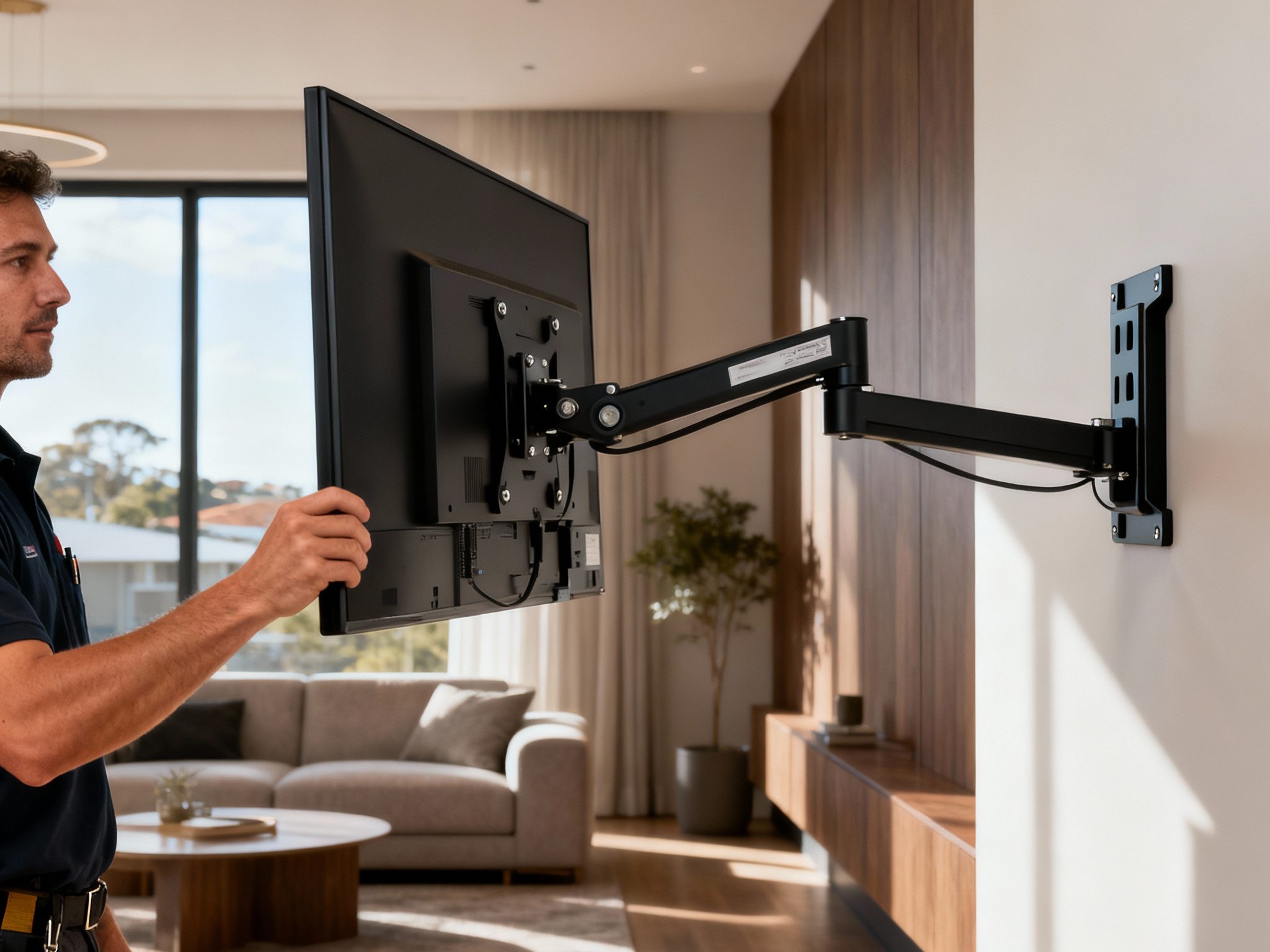
Deciding between an articulating (full-motion) and fixed TV wall mount in Adelaide is one of the most important choices homeowners face when planning a TV installation. Each option brings distinct advantages and trade-offs: fixed mounts offer simplicity, clean aesthetics, and lower cost, while articulating mounts deliver flexibility, multi-angle viewing, and dynamic room arrangements.
Understanding the real differences—beyond marketing hype—helps you choose the right solution for your Adelaide home and viewing habits. This guide compares tv wall mount adelaide articulating vs fixed options across key dimensions, helping you make an informed decision that maximizes both functionality and satisfaction.
Golden Antenna works with both mount types across Adelaide, tailoring recommendations to each home’s unique layout, wall construction, and viewing preferences.
Key Takeaways
- Fixed mounts sit close to the wall, offer highest weight capacity and simplest installation, ideal for straight-on viewing.
- Articulating mounts use extending arms for swivel, tilt, and depth adjustment, perfect for flexible seating or corner placement.
- When comparing tv wall mount adelaide articulating vs fixed options, consider room layout, viewing angles, and frequency of position changes.
- Articulating mounts cost more upfront and require stronger wall fixings, but offer unmatched flexibility for multi-area viewing.
- Fixed mounts deliver cleaner aesthetics, faster installation, and reliability, making them excellent for bedrooms and straightforward lounge setups.
Overview
The choice between fixed and articulating mounts in Adelaide extends beyond personal preference—it’s fundamentally about how your room layout and viewing habits interact with wall construction. Fixed mounts are simpler to install and compatible with more wall types because they don’t create extended leverage stress on fixings. Articulating mounts, by contrast, place significantly higher mechanical loads on wall anchors because the arm extends the TV away from the wall, creating a longer moment arm that multiplies the force at the mounting points.
This technical reality means that when asking about tv wall mount adelaide articulating vs fixed options, a critical factor is your wall type and condition. On solid brick or well-constructed timber-framed walls, articulating mounts are reliable and secure. On older plasterboard, compromised masonry, or thin paneling, a fixed mount might be the only safe choice unless expensive reinforcement is undertaken.
Professional assessment during consultation helps clarify which option suits your specific wall and room.
Fixed Wall Mounts: Strengths and Ideal Use Cases
Fixed mounts hold the TV flush (or nearly flush) against the wall with minimal protrusion. They excel in several scenarios:
Fixed mounts offer simplicity, clean appearance, and excellent load-bearing capacity relative to their size. Bedrooms are ideal candidates—most people watch TV from a single bed position, and the straightforward fixed setup maximizes wall real estate and minimizes visual clutter. Living rooms with seating arranged directly opposite the TV wall also suit fixed mounts perfectly.
Key strengths of fixed mounts include:
- Highest weight capacity per dollar and simplest mechanics
- Minimal wall protrusion (often under 50mm), preserving room aesthetics
- Fastest, easiest installation with fewer fixings required
- Excellent for heritage or delicate walls where minimal intervention preferred
- Lower cost upfront with no moving parts to wear or fail
- Compatible with wider range of wall types and conditions
A fixed mount’s downside is lack of adjustment: if your viewing angle isn’t ideal initially, you’re limited to repositioning the TV only when relocating it entirely. For many Adelaide homeowners, this trade-off is acceptable—the wall becomes clean, simple, and maintenance-free.
Articulating Wall Mounts: Flexibility and Multi-Area Viewing
Articulating (or full-motion) mounts use one or more arms to extend the TV away from the wall and allow swiveling, tilting, and depth adjustment. These mounts transform room usage patterns by enabling dynamic positioning.
Articulating mounts shine when viewing scenarios are complex. Open-plan living areas where seating spans multiple zones benefit dramatically—pull the TV out to view from the kitchen island, swivel it toward the lounge seating, then angle it back to the wall when entertaining. Corner placements become viable: mount the TV at a corner junction and use the articulating arm to angle it toward different areas. Bedrooms with multiple furniture arrangements or homes hosting frequent guests can reposition the TV quickly to suit different needs.
Additional advantages of articulating mounts include:
- Swivel and tilt adjust viewing angle dynamically for comfort
- Extend arm pulls TV away from wall for better angles or hiding cable runs behind
- Corner and unconventional placements become possible
- Flexibility suits homes with changing needs (young families, multi-use rooms)
- Premium aesthetic appeal for contemporary interiors
The downsides include higher cost, more complex installation, greater mechanical wear risk, and the reality that extended arms create visual prominence—the TV becomes a focal point rather than a subtle wall element.
Fixed vs Articulating Mounts: Complete Comparison
| Aspect | Fixed Mounts | Articulating Mounts |
|---|---|---|
| Wall Protrusion | Minimal (under 50mm) | Significant when extended (200–600mm+) |
| Weight Capacity | High relative to size (30–60 kg typical) | Moderate relative to size due to leverage (40–80 kg) |
| Installation Complexity | Simple, fewer fixings required | Complex, more fixings and precise alignment |
| Wall Type Suitability | Works well on most walls, including delicate | Requires solid brick, concrete, or dual studs |
| Viewing Flexibility | Single viewing angle only | Multiple angles, swivel, tilt, extend |
| Aesthetic Impact | Clean, minimal, blends into wall | Prominent, becomes visual focal point |
| Cost Range | Budget to mid-range ($150–$400) | Mid-range to premium ($300–$800+) |
| Maintenance | Virtually none required | Occasional pivot/arm inspection recommended |
| Ideal Room Type | Bedrooms, straight-on living rooms | Open-plan, corners, multi-seating areas |
Room Layout Considerations: When Each Mount Excels
Fixed mounts work perfectly in traditional bedroom layouts where the TV is viewed from the bed at a consistent angle. Similarly, formal living rooms with seating arranged opposite a TV wall benefit from fixed mounts’ simplicity and clean appearance. Guest rooms, kitchens, and secondary spaces where viewing is occasional or from one fixed position suit fixed mounts well.
Articulating mounts shine in open-plan Adelaide homes where living, dining, and kitchen areas merge into one space. Homeowners in these layouts value the flexibility to angle the TV toward different seating clusters without moving the mount itself. Corner placements—mounting the TV at the junction of two walls and using articulation to direct it toward primary seating—create dynamic, space-efficient solutions. Homes with frequent entertaining or varied family activities (kids’ games from the lounge, cooking shows viewed from the kitchen, evening movies from the dining table) benefit from articulating flexibility.
When asking about tv wall mount adelaide articulating vs fixed options, room layout is often the deciding factor.
Wall Condition and Structural Capability
Wall type significantly influences which mount is safe and practical. Solid brick or concrete walls in many older Adelaide properties handle articulating mounts well—the extended leverage is manageable when anchored properly into solid masonry. Timber-framed plasterboard walls are acceptable for articulating mounts only if studs are located at favorable positions (ideally allowing the bracket to engage two or more studs with large lag bolts).
Heritage walls or delicate finishes often favor fixed mounts because they require fewer, smaller fixings and create less stress on aging materials. Tiled or paneled walls typically work better with fixed mounts due to drilling complexity and substrate uncertainty. In coastal Adelaide suburbs, corrosion considerations may influence choice: articulating mounts with more exposed metal are susceptible to salt air corrosion, so material selection and maintenance become more important.
Professional assessment of your specific wall helps clarify which mount type is genuinely feasible and safe.
Practical Installation Differences
Fixed mounts require typically two to four fixings into studs or masonry, aligned horizontally at the TV’s center point. Installation is straightforward: mark, drill, fix, mount the TV. Total time often runs 30–60 minutes for a straightforward fixed installation. Articulating mounts demand precise alignment, careful torque sequencing on multiple arms, and often testing of articulation mechanisms before the TV is mounted. Installation can take 1.5–2 hours or longer, especially on challenging walls.
When considering tv wall mount adelaide articulating vs fixed options, installation time and complexity factor into cost and potential for mistakes. DIY attempts at articulating mounts carry higher risk than fixed installs; professional installation is strongly recommended for articulating systems.
Cable Management Implications
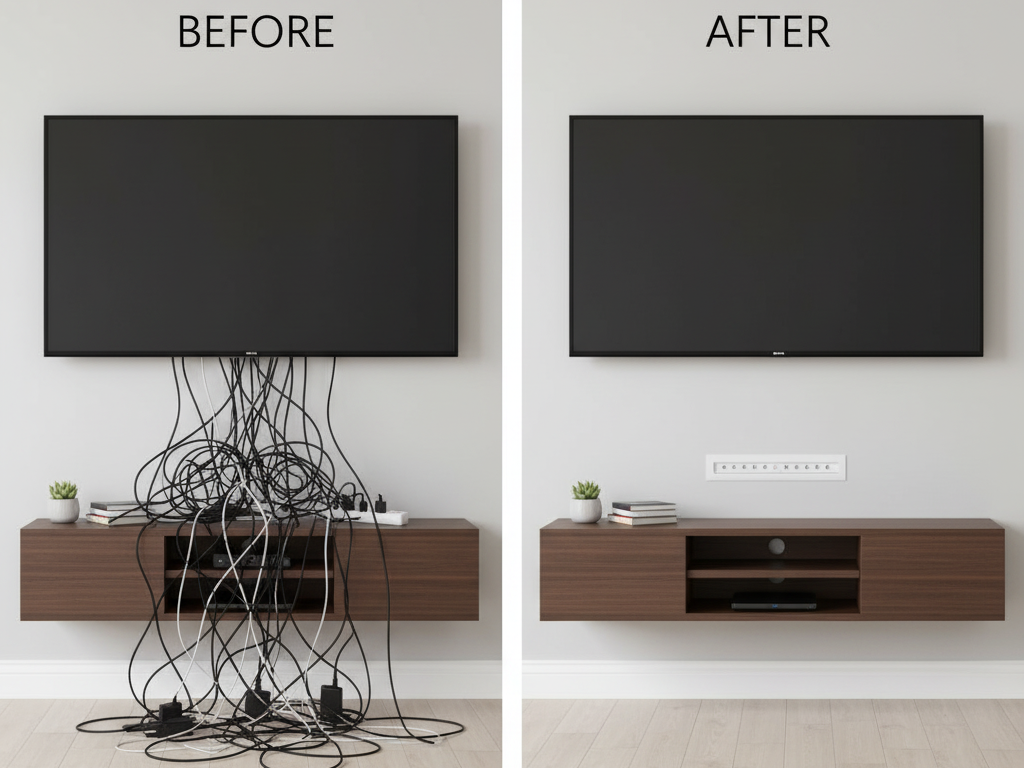
Fixed mounts simplify cable management: power and signals route directly behind the TV to wall outlets, or drop down the wall edge using simple conduit. The TV position never changes, so cable strain and routing remain predictable. Articulating mounts complicate cable management because the TV moves and flexes cables. Professional installers route cables with extra slack behind the mount to allow for extension and articulation without stress, or use flexible conduit that moves with the arm.
This technical detail matters for long-term reliability: poorly managed cables on articulating mounts can fatigue and fail, causing intermittent signal loss or power issues. Another reason professional installation is valuable for articulating systems.
Adelaide-Specific Considerations: Heritage, Coastal, and Modern Homes
Adelaide’s diverse housing stock influences mount choice. Heritage homes in Norwood, Walkerville, and inner suburbs often have delicate original plasterwork or valuable architectural features. Fixed mounts minimize intervention and preserve aesthetics. Modern apartments and townhouses in expanding suburbs like Thebarton or Lightsquare often feature open-plan layouts where articulating flexibility adds real value.
Coastal properties in Glenelg, Semaphore, and Port Adelaide experience salt air exposure. While both mount types work, articulating mounts’ more complex mechanics and exposed pivot points require higher-quality materials and more frequent inspection to prevent corrosion-related failures. Fixed mounts’ simpler design and fewer mechanical points make them slightly lower-maintenance in harsh coastal environments.
Choosing Between Them: Decision Framework
Start by honestly assessing your viewing habits and room layout. If seating faces the TV directly from one position—or positions all roughly aligned—a fixed mount likely serves you perfectly. If your viewing happens from multiple angles, you move between rooms, or you host visitors needing flexible angles, an articulating mount adds genuine value.
Next, have your wall assessed. Professional inspection confirms whether studs or masonry can reliably support an articulating mount’s extended leverage. If wall condition is uncertain or reinforcement would be required, fixed mounts become the safer, simpler choice.
Finally, weigh aesthetics and long-term satisfaction. A fixed mount delivers clean minimalism; an articulating mount makes the TV a dynamic, adjustable element. Neither is wrong—the right choice aligns with how you actually use your space.
When evaluating tv wall mount adelaide articulating vs fixed options, this three-step framework helps clarify the best fit for your situation.
Frequently Asked Questions (FAQs)
Q: What’s the main difference between fixed and articulating TV mounts?
A: Fixed mounts hold the TV flush to the wall with no adjustment. Articulating mounts use arms to extend, swivel, and tilt the TV, allowing dynamic repositioning without moving the bracket itself.
Q: Which mount type is safer?
A: Both are equally safe when properly installed for their intended use. Fixed mounts are simpler and work on more wall types. Articulating mounts require stronger walls and more rigorous installation but are safe on solid brick, concrete, or well-framed walls.
Q: Can I use an articulating mount on a plasterboard wall?
A: Only if the bracket can engage solid studs with large lag bolts, not just plasterboard anchors. Weak or compromised plasterboard cannot safely support an articulating mount’s extended leverage. Professional assessment is essential.
Q: Which mount costs more?
A: Articulating mounts typically cost 50–100% more than comparable fixed models due to their mechanical complexity. Installation costs also run higher for articulating systems.
Q: Is an articulating mount worth the extra cost for a bedroom TV?
A: Rarely. Bedroom viewing is usually from one fixed position (the bed), so a fixed mount delivers the same satisfaction at lower cost. Articulating mounts excel in multi-area viewing spaces like open-plan living.
Q: Do articulating mounts require maintenance?
A: Occasional inspection of pivot points and joints is wise, especially in coastal areas. Fixed mounts are essentially maintenance-free.
Q: Can I change my mind and switch from fixed to articulating later?
A: Yes, but you’ll need to fill old fixing holes and potentially reinforce the wall for articulating brackets. Planning for the right choice upfront avoids this cost.
Conclusion
The choice between fixed and articulating TV mounts in Adelaide ultimately hinges on your viewing habits, room layout, and wall construction. Fixed mounts deliver simplicity, reliability, and aesthetic minimalism at lower cost—ideal for traditional bedroom setups and straightforward lounge rooms. Articulating mounts provide unmatched flexibility for multi-area viewing, corner placements, and dynamic room arrangements—perfect for open-plan Adelaide homes and spaces with varied entertainment needs.
When comparing tv wall mount adelaide articulating vs fixed options, professional guidance clarifies which system is both safe for your specific wall and right for how you actually use your space. Golden Antenna’s Adelaide team helps you navigate this decision, assesses your wall’s structural capability, and delivers expert installation ensuring long-term satisfaction and safety.
Contact Golden Antenna at 0403 711 983 to discuss fixed vs articulating options for your Adelaide home and get tailored recommendations aligned with your viewing needs and wall conditions.
