
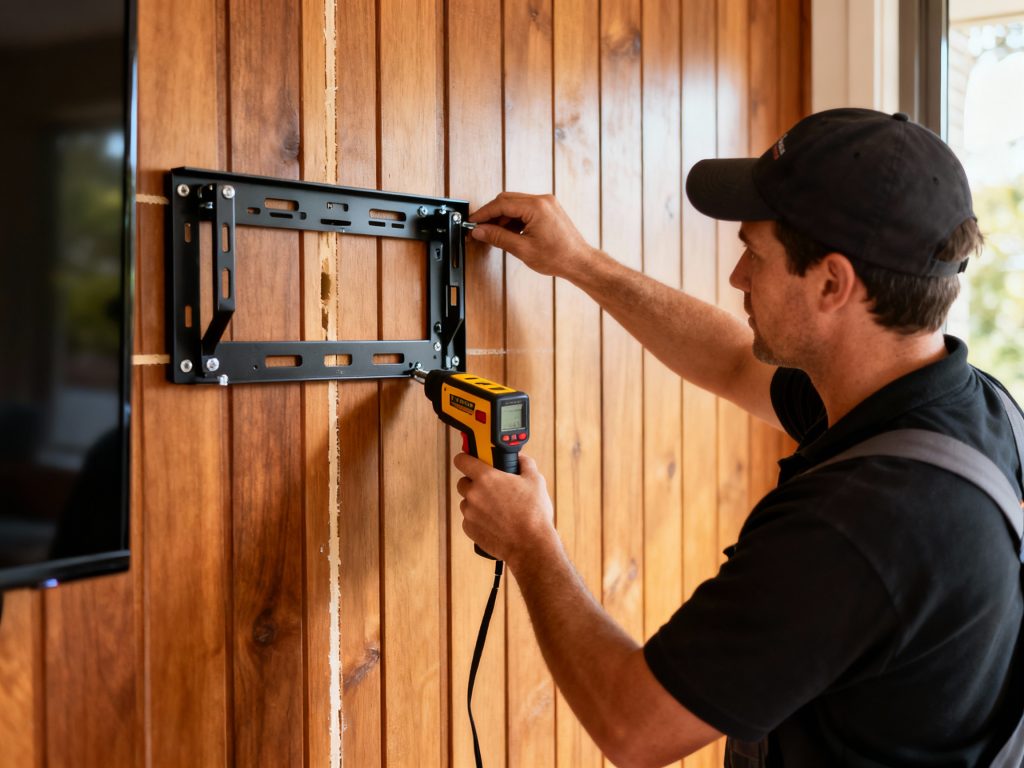
Many Adelaide homes feature beautiful wood-paneled walls—from retro 1970s interiors to modern feature wall designs. Mounting a TV on paneled walls presents unique challenges that differ significantly from standard drywall or brick installations. Understanding the proper techniques, hardware requirements, and safety considerations is essential before attempting can you mount tv on paneled walls in Adelaide. This comprehensive guide explains the structural considerations, best practices, and when professional installation becomes necessary.
Golden Antenna specializes in TV mounting across Adelaide’s diverse wall types, including challenging paneled surfaces. Our expert team understands how to safely secure your TV on paneled walls while preserving the aesthetic integrity of your space.
Key Takeaways
- Wood paneling thickness (½ inch or greater) can support TV mounts if properly anchored to studs or reinforced with backing plates.
- Thinner wood paneling requires wall stud reinforcement and specialized anchoring hardware for safe TV mounting.
- Professional stud location identification is critical—mounting directly to paneling alone risks instability and damage.
- Reinforcement plates (plywood or MDF backing) distribute weight evenly and prevent panel sagging in paneled wall installations.
- Can you mount tv on paneled walls in Adelaide safely depends on wall assessment, correct hardware selection, and professional installation expertise.
Overview
Paneled walls in Adelaide homes present distinct installation challenges. Unlike solid brick or uniform drywall, wood paneling consists of individual boards often attached to studs with gaps or cavities behind them. These gaps create uncertainty about structural support, and improper mounting can damage the panels, create visible holes, or worse—result in TV falls causing serious injury.
Understanding wall construction becomes essential for can you mount tv on paneled walls in Adelaide safely. Different panel thicknesses, aging materials, and construction methods all influence mounting decisions. Professional assessment determines whether paneling alone provides adequate support or whether studs must be accessed through the panels for secure, safe installation.
The stakes are high: a falling TV poses catastrophic risks to both property and personal safety. This is why Adelaide residents increasingly turn to professional TV mounting services rather than attempting DIY approaches on unfamiliar wall types.
| Aspect | DIY Approach | Professional Installation |
|---|---|---|
| Stud Detection | Uncertain, may guess incorrectly | Verified with professional tools and expertise |
| Fastener Selection | Often undersized or inappropriate | Correctly rated for weight and panel type |
| Reinforcement Assessment | Frequently missed or inadequate | Professional evaluation determines necessity |
| Installation Safety | High risk of failure or damage | Guaranteed safe, tested installation |
| Panel Damage | Common—visible holes, deformation | Minimized through expert techniques |
| Cable Management | Usually poor; cables visible | Professional routing and concealment |
| Warranty | None; full liability on homeowner | Installation warranty protects investment |
| Insurance Validity | May void insurance on damage claims | Documentation supports insurance coverage |
| Long-Term Stability | May fail within 1–3 years | Reliable performance 8–10+ years |
Understanding Panel Wall Structure and Materials
Panel Thickness Assessment
Panel thickness critically determines mounting safety:
- ½ inch (12mm) or thicker: Can support small to medium TVs (up to 43″) if anchored properly, but stud mounting is still recommended for heavier sets
- ¼ to 3/8 inch (6–10mm): Too thin to rely on alone; absolutely requires stud mounting or reinforcement backing plates
- Solid wood vs. veneer: Solid wood panels provide better holding power than thin veneer over hollow backing
To determine your panel thickness, carefully examine an outlet plate edge or remove a small section to measure. Understanding this critical detail informs all subsequent installation decisions.
Common Adelaide Panel Types
- Vintage wood paneling (1960s–1980s): Often ½–¾ inch thick; studs typically 16 inches on center
- Modern decorative panels: Varying thicknesses; may be veneered or solid wood
- Shiplap and tongue-and-groove: Feature interlocking edges; studs usually visible at seams
- Feature wall paneling: Often professionally installed; requires careful assessment before TV mounting
Understanding your specific panel type helps determine optimal mounting strategies and hardware selection.
Assessing Your Paneled Wall for TV Mounting
Locating Studs Behind Paneling
Finding studs behind panels is essential for safe TV mounting. Multiple methods help identify stud locations:
Visual Inspection:
- Panel seams often align with stud locations
- Small nail holes or fastener lines frequently indicate stud placement
- Electrical outlets and light switches mount adjacent to studs (building code requirement)
Using Tools:
- Electronic stud finders work through paneling but may require adjustment for wood thickness
- Magnetic stud finders locate metal fasteners along stud lines
- Combination tools using multiple technologies increase accuracy on thick paneling
Physical Methods:
- Tapping the wall produces different sounds over studs (solid) versus hollow areas (hollow)
- Carefully probing with small nails shows stud resistance versus easy penetration
Professional TV mounting services use advanced stud-finding technology ensuring accurate identification, eliminating guesswork and installation errors.
Weight Capacity Evaluation
Understanding what your paneled wall can safely support is critical:
Factors affecting capacity:
- Panel thickness and material density
- Stud spacing and quality
- Fastener type and size (larger fasteners hold more weight)
- Panel age and condition (deterioration reduces capacity)
- Overall wall structural integrity
For can you mount tv on paneled walls in Adelaide safely, professional assessment calculates precise weight limits based on these factors. Never assume capacity without verification.
Hardware Selection for Paneled Wall Installation
Appropriate Fasteners for Wood Paneling
Different fastener types suit specific paneling situations:
Stud-Mounted Fasteners (Best Practice):
- Heavy-duty lag screws (3/16″ diameter minimum, 3″ length)
- Bolts with washers for maximum holding power
- Rated for 50+ lbs per fastener into solid studs
Through-Panel Fasteners (When Studs Unavailable):
- Toggle bolts: open behind panel to spread pressure; support 20–50 lbs depending on quality
- Molly bolts: expand inside cavities; provide 15–40 lbs support per anchor
- Heavy-duty plastic anchors: only if specifically rated for TV weight; generally support 10–20 lbs
Reinforcement Options:
- Plywood backing plates (¾ inch minimum): distribute weight across wider panel area
- MDF boards: effective for reinforcement with construction adhesive
- Steel angle braces: provide structural support for heavy TVs
Bracket Selection for Paneled Walls
Mount type influences both aesthetics and installation approach:
Fixed Mounts:
- Mount directly to studs through paneling
- Minimal bracket depth preserves paneling appearance
- Weight capacity highest with stud mounting
Tilting Mounts:
- Adjustable viewing angles accommodate panel mounting height variations
- Require stud mounting for safety with larger TVs
- Better for panels where optimal height doesn’t align with studs
Full-Motion Mounts:
- Articulating arms require strong stud-mounted anchoring
- Best reserved for confirmed stud locations
- Most expensive but provide maximum flexibility
Professional installers ensure bracket selection matches paneling conditions and weight requirements, eliminating risk of undersized hardware.
Safe Installation Methods for Paneled Walls
Pre-Installation Assessment Process
Professional approach ensures safety and success:
- Stud location verification using multiple methods
- Panel thickness measurement determining fastener length requirements
- Weight capacity calculation based on panel and stud condition
- Viewing position determination establishing optimal mounting height
- Cable routing planning minimizing visible wires and wall damage
- Reinforcement assessment determining if backing plates necessary
This methodical approach prevents costly errors and installation failures.
Common Mistakes and How to Avoid Them
Mounting Without Stud Verification
Mistake: Assuming panel thickness provides adequate support without confirming stud location
Consequence: Panel deformation, bracket failure, falling TV
Prevention: Always verify studs; use multiple location methods; confirm with pilot holes
Undersized Fasteners
Mistake: Using standard wall anchors or small screws in paneling
Consequence: Fastener pullout, installation failure, safety hazards
Prevention: Use heavy-duty fasteners rated for TV weight; lag screws minimum ⅛” diameter
Poor Cable Management
Mistake: Leaving cables exposed or routing them carelessly
Consequence: Aesthetic problems, tripping hazards, water damage risks
Prevention: Route cables through panel cavities or use professional conduit systems
Inadequate Reinforcement
Mistake: Mounting heavy TVs on thin paneling without backing plates
Consequence: Gradual panel sagging, bracket shifting, eventual failure
Prevention: Use reinforcement plates for TVs over 43″ on thin paneling
Ignoring Panel Condition
Mistake: Installing on deteriorated, warped, or water-damaged paneling
Consequence: Installation failure, panel damage, safety risks
Prevention: Assess panel integrity; replace damaged sections; address moisture problems first
Reinforcement Techniques for Paneled Walls
When Reinforcement Becomes Necessary
Reinforcement backing plates strengthen weak paneling:
- TVs over 43 inches on paneling under ½ inch thick
- Mounting locations not aligned with studs
- Thin veneered panels over hollow backing
- Aging or compromised paneling material
- Desired installation at specific locations where studs unavailable
Installation Process
- Select backing material: ¾ inch plywood or ½ inch MDF minimum
- Cut backing to size: Typically 16–24 inches square
- Apply construction adhesive: to backing board back surface
- Position behind bracket: Align with mounting hole locations
- Secure through paneling: Use 3-inch screws into studs or multiple fasteners
- Allow adhesive cure time: Per manufacturer specifications
- Mount bracket: to reinforced backing plate
- Install TV: Following all manufacturer specifications
Reinforcement creates a load-distribution surface preventing concentrated stress on thin paneling.
Special Considerations for Adelaide Paneled Walls
Heritage and Vintage Panel Preservation
Many Adelaide properties feature original or heritage-quality paneling deserving careful handling. Mounting a TV on these surfaces requires:
- Assessment by professionals familiar with heritage values
- Minimal visible damage techniques
- Reversible fastening methods where possible
- Documentation for preservation records
Professional installers understand how to work respectfully with vintage materials, maintaining property character while achieving modern functionality.
Moisture and Climate Considerations
Adelaide’s variable climate affects paneled walls:
- Summer heat can cause wood expansion and contraction
- Moisture from ocean breezes (especially in coastal suburbs) affects wood stability
- Aging panels may have compromised structural integrity from environmental exposure
Professional assessment identifies climate-related issues before installation, preventing future problems.
When Professional Installation is Essential
Can you mount tv on paneled walls in Adelaide safely? Yes—but professional consultation becomes essential when:
- Panel thickness cannot be confirmed
- Stud location is uncertain or inaccessible
- TVs exceed 50 inches
- Panels show age, damage, or warping
- You desire reinforcement backing installation
- Heritage or specialty panels require careful handling
- Moisture or structural concerns exist
Golden Antenna’s professional installation services provide assessment, planning, and guaranteed safe installation addressing these concerns comprehensively.
FAQs
Q: Can you mount tv on paneled walls in Adelaide?
A: Yes, with proper assessment and installation. Panel thickness, stud location verification, and appropriate fastener selection are critical. Thinner paneling (under ½ inch) requires reinforcement. Professional installation ensures safety.
Q: What thickness of wood paneling can safely support a TV?
A: ½ inch (12mm) or thicker can support small-to-medium TVs when properly mounted. Thinner paneling requires reinforcement backing plates or stud mounting. Always verify stud locations for heavier TVs.
Q: Do I need to mount into studs behind paneling?
A: For heavy TVs (over 43″) or thin paneling (under ½ inch), stud mounting is essential. Even with thick paneling, studs provide maximum safety. Never rely on paneling alone for large TV installations.
Q: What fasteners should I use for paneled wall TV mounting?
A: Use heavy-duty lag screws (minimum 3/16″ diameter, 3″ length) into studs. For non-stud locations, toggle bolts or reinforcement backing plates distribute weight. Never use standard wall anchors.
Q: How do I find studs behind wood paneling?
A: Use electronic stud finders adjusted for wood thickness, look for panel seams and fastener lines, check electrical outlet locations, or tap the wall to detect solid vs. hollow areas. Professional verification ensures accuracy.
Q: What is a reinforcement backing plate?
A: A plywood or MDF board (typically ¾ inch thick) mounted through paneling and secured to studs, creating a larger load-distribution surface for TV bracket mounting. Essential for thin paneling or mounting locations without convenient studs.
Q: Will TV mounting damage my wood paneling?
A: Proper installation minimizes damage through careful fastener placement and professional techniques. Poor installation causes holes, deformation, and panel damage. Professional experts minimize aesthetic impact.
Conclusion
Can you mount tv on paneled walls in Adelaide? Absolutely—but success depends on proper assessment, appropriate hardware selection, and expert installation techniques. Understanding panel thickness, locating studs accurately, and selecting correct fasteners form the foundation of safe, reliable TV mounting on paneled surfaces.
Wood-paneled walls add character and warmth to Adelaide homes, and with proper installation methods, TVs can integrate seamlessly without compromising aesthetic integrity or structural safety. Whether your paneling is vintage heritage-quality or modern decorative, professional assessment determines optimal mounting approaches.
Golden Antenna combines Adelaide expertise with paneled wall specialization, delivering safe, visually appropriate TV installations on even the most challenging surfaces. Contact our team at professional services for consultation on your paneled wall TV mounting project.
For guaranteed safe, expert installation on paneled walls in Adelaide, contact Golden Antenna at 0403 711 983 today.
