
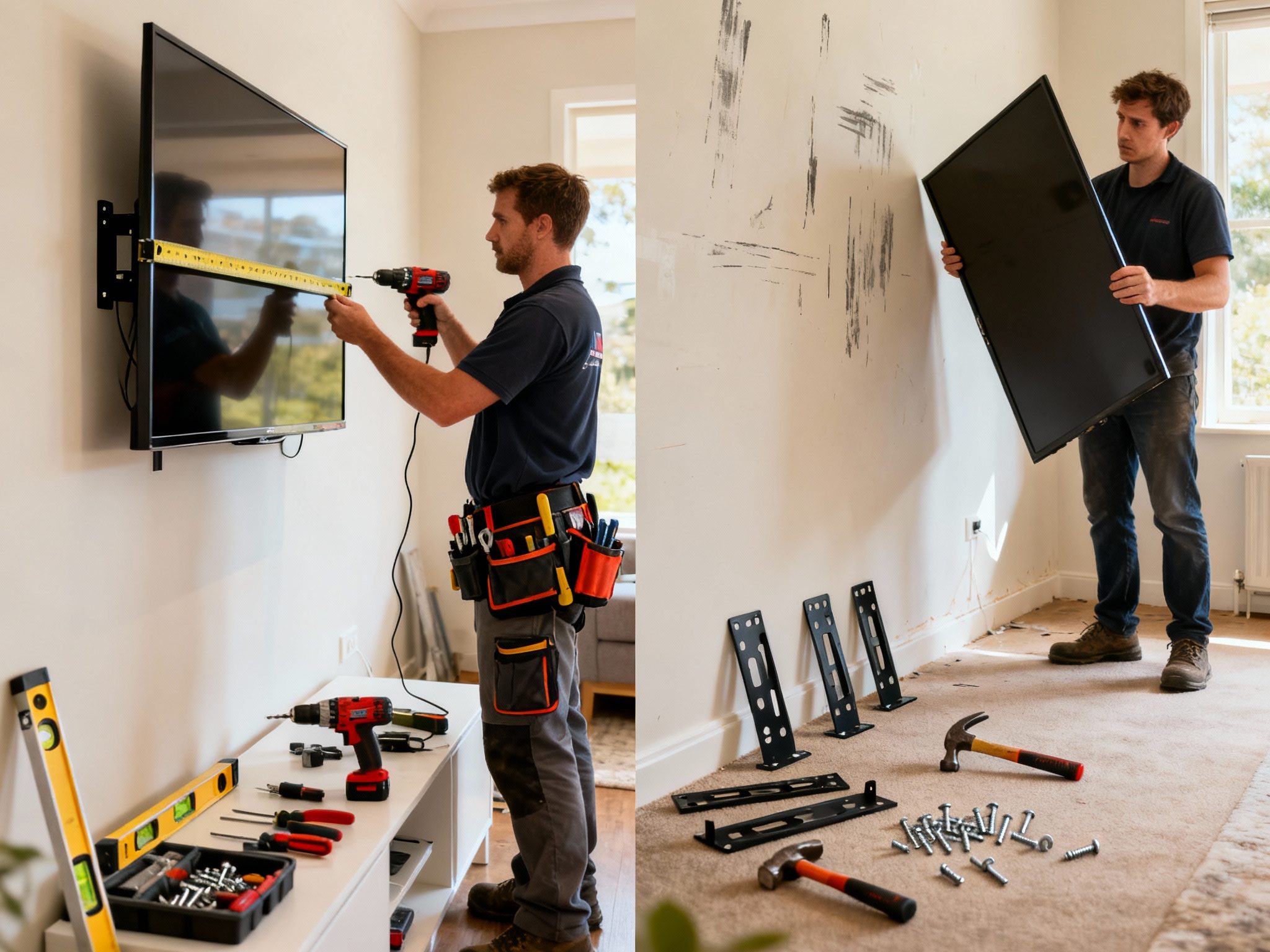
Standing in front of your new TV, you face a choice: attempt the mounting yourself or hire a professional. While DIY might seem like a money-saving shortcut, the reality of professional tv wall mounting installation vs diy is far more nuanced. Improper installation can damage your TV, walls, or worse—cause your TV to fall, risking injury. This comprehensive guide compares both approaches, examining costs, safety, quality, and long-term value to help you make an informed decision.
Golden Antenna helps Adelaide homeowners understand when professional installation is genuinely the better investment and when professional expertise truly matters.
Key Takeaways
- DIY TV mounting appears to save money initially but often incurs hidden costs through tools, mistakes, and repairs.
- Professional tv wall mounting installation vs diy fundamentally differs in expertise, equipment access, warranty coverage, and safety assurance.
- Common DIY failures include incorrect stud location, undersized fasteners, improper cable routing, and incorrect viewing height positioning.
- Professional installers complete jobs in 1–3 hours with proper assessment, secure fastening, testing, and comprehensive documentation.
- Insurance validity, property damage protection, and long-term reliability make professional installation the safer financial choice for most homeowners.
Overview
Comparing professional tv wall mounting installation vs diy requires looking beyond the initial price tag. DIY projects appeal because they seem economical, but total cost-of-ownership often tells a different story. Professional installation provides expertise, proper equipment, safety assurance, and warranty coverage—elements that protect your valuable TV investment and home.
Understanding what you’re actually paying for with each approach helps clarify the decision. DIY costs might include bracket purchase (AUD 50–300), tool acquisition (AUD 100–400), and potential repairs if mistakes occur (AUD 200–1000+). Professional installation typically costs AUD 250–500 but includes assessment, safe fastening, testing, documentation, warranty, and insurance protection. When repairs from DIY failures are factored in, professional installation often costs less overall while eliminating risk.
Cost Comparison: DIY vs Professional TV Mounting
| Cost Factor | DIY Approach | Professional Installation |
|---|---|---|
| Bracket/Mount Hardware | AUD 50–300 | Included or AUD 25–150 |
| Tools Purchase/Rental | AUD 100–400 | Included (professional equipment) |
| Labor/Time Investment | 6–12 hours (valued at AUD 180–360+) | 1–3 hours (AUD 250–500 service fee) |
| Cable Management | Often DIY or lacking (AUD 0–100) | Professional routing included (AUD 50–200 value) |
| Potential Repair Costs | AUD 200–1500+ (if mistakes occur) | Covered by warranty/liability insurance |
| Documentation/Insurance | None | Comprehensive (insurance protection) |
| Warranty/Guarantee | None | 6–12 month workmanship warranty |
| Total Typical Cost | AUD 350–2500+ (if errors occur) | AUD 250–500 (all-inclusive) |
| Cost if Mistakes Occur | AUD 1500–3500+ | Protected by warranty |
The True Cost of DIY TV Mounting
Initial Investment and Hidden Expenses
DIY mounting seems inexpensive at first glance: purchase a bracket and grab your personal tools. However, most homeowners lack specialized mounting equipment, creating hidden costs. You may need to purchase or rent:
- Stud finder (electronic model for accuracy): AUD 50–200
- Drill/driver with various bits: AUD 80–300 if purchasing new
- Level and measuring tools: AUD 30–100
- Specialized drill bits for different wall types: AUD 20–60
- Wall anchors and fasteners appropriate for your wall: AUD 15–50
- Possible cable management materials: AUD 30–100
These cumulative costs often total AUD 200–500 before any installation work begins. Many DIYers find they don’t have the right tools, forcing purchases that eliminate any cost advantage over professional installation.
Risk of Costly Mistakes
DIY installation errors frequently require expensive corrections. Drilling into electrical wiring risks serious injury or requiring an electrician visit (AUD 150–400). Mounting into weak plasterboard without studs causes the bracket to fail, potentially requiring wall repairs (AUD 200–500) plus mount replacement (AUD 50–300). Cracked tiles on a feature wall necessitate professional tile replacement (AUD 300–800). A TV that falls due to failed mounting may require complete replacement, potentially exceeding AUD 1500+.
Professional installers carry liability insurance protecting you if something goes wrong during installation, whereas DIY failures are your full responsibility with no recourse.
Time Investment and Opportunity Cost
Even setting aside mistakes, DIY mounting requires significant time investment. Research, planning, acquiring tools, and performing the installation often takes 6–12 hours when accounting for YouTube tutorials, learning curves, and correction attempts. At a modest hourly value (AUD 30/hour), that represents AUD 180–360 in time alone. When mistakes require additional corrections, time investment doubles or triples, making the “cost saving” minimal after valuing your time appropriately.
The Professional Installation Advantage
Expertise and Experience
Professional installers have trained extensively with various wall types, TV sizes, mounting systems, and cable management approaches. They instantly identify studs, assess wall strength, select appropriate fasteners, and position mounts for optimal viewing comfort. This expertise prevents costly errors, delivers superior results, and works efficiently.
When asking about professional tv wall mounting installation vs diy, expertise is the primary differentiator. Professionals assess multiple factors during installation:
- Actual wall construction (brick, concrete, timber-framed plasterboard, paneling, tile)
- Structural integrity and hidden obstacles behind visible surfaces
- TV weight and appropriate bracket load rating matching
- Safe viewing height and angle from your typical seating position
- Electrical outlet locations and potential wiring hazards
- Optimal cable routing preserving aesthetics and accessibility
This comprehensive assessment eliminates guesswork that DIYers rely on, ensuring installation safety and quality.
Access to Specialized Equipment
Professional installers invest in equipment that delivers superior results. Quality stud finders with advanced detection capabilities, precision levels, specialized drill bits for every wall type, and professional-grade anchors and fasteners are standard tools. They also carry backup equipment in case primary tools fail mid-installation, ensuring job completion on schedule.
Professional equipment translates to faster installation (typically 1–3 hours) compared to DIY attempts that often take 4–8 hours or require multiple sessions. The speed difference reflects both expertise and equipment quality, with professional installers delivering polished results efficiently.
Documentation and Warranty Coverage
Professional installations include comprehensive documentation: photos of the installation process, bracket specifications, fastener details, wall assessment notes, and any structural modifications made. This documentation is invaluable for:
- Insurance claims if damage occurs post-installation
- Landlord verification in rental properties
- Future real estate transactions when selling your home
- Warranty claims if something goes wrong
- Professional accountability if problems arise
Professional installations typically include guarantees stating the installer will address any issues arising from their workmanship within 6–12 months post-installation. This warranty provides peace of mind unavailable with DIY approaches.
Common DIY Mistakes That Cost Money
Incorrect Stud Location and Fastening
The most frequent DIY error is mounting brackets onto plasterboard without confirming stud location or using undersized anchors. Plasterboard alone cannot support heavy TVs long-term; brackets must penetrate to studs or use reinforcement. DIYers often miss studs or use inappropriate anchors, leading to bracket failure within weeks or months. This mistake sometimes costs only the price of remounting (AUD 50–150) but frequently results in wall damage repair (AUD 200–400) plus bracket replacement (AUD 50–300).
Undersized or Incorrect Fasteners
Using standard wall anchors, small screws, or fasteners intended for lighter applications is another common mistake. These fasteners cannot support TV weight, causing gradual bracket loosening or sudden failure. The consequences range from watching a TV tilt dangerously to catastrophic falls requiring replacement.
Poor Viewing Position
Many DIYers mount TVs at aesthetically convenient heights rather than optimal viewing heights. Mounting too high causes neck strain; mounting too low requires uncomfortable forward bending. While adjusting height doesn’t cost money, it demonstrates the difference between “mounted” and “professionally installed.” Professionals position TVs for comfort and safety, not just convenience.
Inadequate Cable Concealment
DIY installations often leave cables visible along walls, creating unsightly tangled messes. Professional concealment (in-wall routing or attractive conduit) adds cost but improves aesthetics and protects cables from damage. Visible cables also create tripping hazards, especially in busy areas or homes with children or pets.
Safety and Insurance Considerations
Injury Risks with DIY Installation
Mounting TVs, especially large, heavy models (50″+), involves physical risks. Lifting awkwardly can cause back or shoulder injuries. Working at height on ladders risks falls. Drilling into walls without knowing what lies behind (wiring, plumbing) can cause electrical shock or flooding. Professional installers follow safety protocols, carry insurance, and know hazard identification, minimizing these risks.
Insurance Validity and Property Protection
Many homeowners insurance policies require professional installation for coverage eligibility. DIY installation may void coverage, leaving you personally liable for damage. If a DIY-mounted TV falls and injures someone, your liability coverage may not apply. Professional installation provides documented proof satisfying insurance requirements and protecting you from liability disputes.
Cable and Electrical Safety
When asking about professional tv wall mounting installation vs diy, electrical safety is critical. Professional installers understand electrical codes and can safely coordinate with in-wall wiring, outlet additions, or cable routing without creating hazards. DIYers often create fire risks or shock hazards through improper cable placement or inadequate protection.
When DIY Mounting Might Be Acceptable
Lightweight TVs on Simple Drywall
If your TV weighs under 15 kg, mounting is drywall without obstacles or special requirements, and you’re confident with power tools, DIY may be feasible. Even then, professional installation costs only slightly more and eliminates risks entirely. The minimal savings rarely justify potential problems.
Secondary or Temporary Installations
If mounting a lightweight TV in a space where damage is acceptable (garage, guest room where you’re willing to patch holes), DIY poses lower stakes. Even then, if you have any doubt, professional installation’s cost is modest insurance against mistakes.
Rented Properties with Landlord Permission
In rentals where damage minimizes future references, and you’ve received landlord approval for wall modifications, DIY may be acceptable. Using removable mounting systems specifically designed for rentals (damage-free mounts) reduces risk compared to traditional bracket installation.
When Professional Installation is Essential
Professional tv wall mounting installation vs diy becomes obviously professional-favorable when:
- TVs exceed 50 inches or weigh more than 30 kg
- Wall construction is uncertain (brick, tile, paneling, heritage properties)
- Viewing location is in high-traffic areas with children or pets
- In-wall cable concealment is desired
- Electrical outlet installation or upgrades are needed
- Property insurance requires professional installation
- You value your time and want guaranteed quality
- The property is owned and professionally maintained
- Long-term reliability and warranty protection matter
Essentially, if you have any uncertainty, professional installation is the safer choice.
Making Your Decision
When evaluating professional tv wall mounting installation vs diy, consider your specific situation:
Ask yourself whether you possess the required tools (stud finder, appropriate drill bits, level, correct fasteners). Assess your confidence with power tools and following detailed instructions. Honestly evaluate whether you could handle complications if discovered mid-installation (wrong wall construction, hidden obstacles, necessary repairs). Consider whether your time is better invested elsewhere, especially when professional cost is modest. Factor insurance validity and property protection into your decision.
If you answered “no” to any of these questions, professional installation is the right choice. When uncertainty exists, professionals eliminate risk and typically cost less overall than DIY mistakes and corrections.
Frequently Asked Questions (FAQs)
Q: What is the real cost difference between professional tv wall mounting installation vs diy?
A: DIY initial costs appear lower (AUD 200–500 total), but hidden tool costs and high risk of expensive mistakes often make professional installation (AUD 250–500) cheaper overall, especially when professional warranty and liability protection are included.
Q: Can I save money with DIY TV mounting?
A: Possibly, but only if you already own all necessary tools and your wall is straightforward drywall with accessible studs. Any complications or mistakes eliminate savings quickly, often resulting in higher total costs than professional installation would have been.
Q: What are the biggest risks of DIY TV mounting?
A: Major risks include drilling into electrical wiring (shock hazard), mounting into plasterboard without studs (bracket failure), incorrect viewing height (neck strain), damaged walls requiring repair, and TV falls risking injury or equipment destruction.
Q: Does my insurance require professional TV installation?
A: Many policies do. Check your insurance documentation or contact your provider. Professional installation often satisfies requirements, while DIY installation may void coverage for TV-related damage or injuries.
Q: How long does professional TV mounting take?
A: Standard installations typically require 1–3 hours, including assessment, installation, testing, and cable management. This speed reflects professional expertise and proper equipment.
Q: What warranty do professional installers provide?
A: Reputable professionals typically guarantee their workmanship for 6–12 months, addressing any issues arising from their installation. DIY installations include no such protection.
Q: When should I definitely hire a professional?
A: Always hire professionals for TVs over 50 inches, uncertain wall types, high-value properties, installations in busy areas with children or pets, or any situation where you have doubt about your capabilities.
Conclusion
The comparison between professional tv wall mounting installation vs diy ultimately favors professional installation for most homeowners. While DIY seems economical initially, hidden tool costs, high mistake risk, and lack of warranty or insurance protection often make professional installation the smarter financial and practical choice. Professional expertise ensures safety, proper positioning, aesthetic cable management, and long-term reliability—elements worth investing in for something as important as your home entertainment system.
Golden Antenna delivers professional TV mounting across Adelaide with transparent pricing, comprehensive assessment, quality workmanship, and warranty protection. For most homeowners, professional installation eliminates stress, ensures quality, and protects your valuable investment far better than DIY approaches.
Contact Golden Antenna at 0403 711 983 for professional TV mounting consultation and competitive quotes.
