
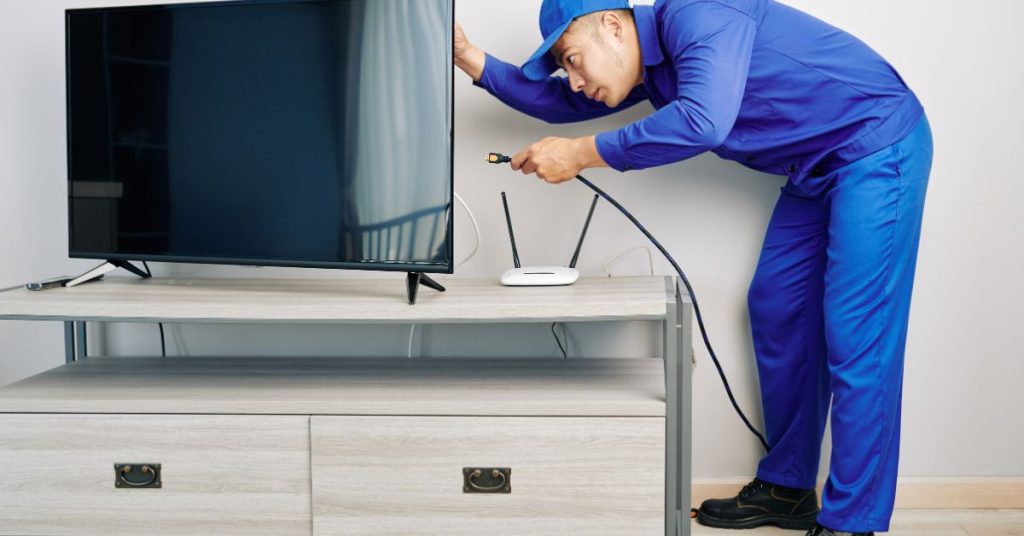
Picture your newly wall-mounted television looking absolutely stunning against the wall—perfectly centered, ideally positioned, and completely ruined by a tangled mess of cables dangling down like an electrical octopus. This scenario plays out in countless Adelaide homes where homeowners successfully mount their TVs only to discover that cable management requires just as much planning as the mounting itself.
The aesthetic appeal of wall-mounted entertainment disappears instantly when messy wires steal visual attention. If you’re asking how do you hide cables from wall mounted tv, you’re recognizing that beautiful installations demand complete solutions including proper wire concealment. Adelaide’s diverse housing styles present unique challenges for cable routing, from heritage plasterwork that restricts drilling to modern homes where electrical codes demand specific approaches.
This guide reveals professional cable management techniques that transform cluttered wire situations into invisible infrastructure supporting seamless viewing experiences without compromising safety or functionality.
Key Takeaways
- • Effective cable concealment involves multiple techniques beyond simple wire covers, including in-wall routing, conduit systems, and strategic outlet placement for hidden connections.
- Understanding how do you hide cables from wall mounted tv requires knowledge of electrical codes, safe cable handling, and Adelaide’s specific building regulations that govern wall modifications.
- Common mistakes include routing power cables through walls illegally, bending cables excessively, mixing power and signal lines, and using inadequate concealment methods that fail aesthetically.
- In-wall cable routing requires professional expertise to avoid puncturing electrical wires, plumbing pipes, and structural elements hidden within walls that create expensive damage.
- Professional cable management combines technical expertise with aesthetic vision, delivering hidden infrastructure that maintains safety compliance while creating the seamless look homeowners desire.
Overview
Wall-mounted televisions create clean, modern aesthetics that appeal to contemporary homeowners seeking space-saving solutions. However, the visual appeal depends entirely on successful cable management. Exposed wires undermine even perfectly executed mounting installations, creating cluttered appearances that distract from viewing experiences.
Cable concealment involves more complexity than simply hiding wires—electrical codes restrict power cable routing through walls, signal cables demand proper handling preventing degradation, and structural considerations limit modification options. Adelaide’s varied housing construction presents specific challenges, from older plaster walls where drilling risks hidden hazards to heritage properties where external modifications face regulatory restrictions.
Understanding how do you hide cables from wall mounted tv requires examining multiple concealment methods, their limitations, safety requirements, and why professional installation eliminates risks that DIY cable routing creates. This exploration examines professional techniques delivering hidden infrastructure supporting optimal viewing without compromising safety or code compliance.
The Challenge of In-Wall Cable Routing
Running cables through walls appears straightforward until hidden obstacles emerge. Electrical wiring, plumbing pipes, timber framing, and previous installations hide behind wall surfaces.
Drilling blind into walls risks puncturing these hidden elements, creating electrical hazards, water damage, or structural compromise. Adelaide’s older homes present particular challenges with non-standard framing, asbestos-containing materials, and heritage restrictions limiting drilling locations.
Professional installers use advanced detection equipment identifying obstacles before drilling begins. Thermal imaging cameras reveal temperature differences from electrical wiring. Radar-based scanners penetrate walls detecting metal pipes and wooden studs.
Moisture meters identify water-saturated areas indicating plumbing locations. These tools combined with experience allow safe cable routing through otherwise hazardous wall spaces.
Cable pathways must accommodate slope for drainage if water infiltration occurs. Tight bends damage internal wire insulation, causing signal loss or equipment failure. Cables routing horizontally require supports preventing sagging that eventually stresses connections.
Vertical runs need protection from physical damage where cables pass through accessible areas. These technical requirements separate successful installations from amateur attempts causing problems months after completion.
No Studs? How to Mount a TV on Drywall Securely
Professional guide to safe drywall TV mounting without studs
| Anchor Type | Specifications | Application |
|---|---|---|
| Toggle Bolts | ||
| Load capacity | 20-30kg with spring-loaded wings spreading load across wall | Strongest option for smaller televisions |
| Mechanism | Spring-loaded wings flip open behind drywall creating enormous holding pressure | Superior load distribution across large wall surface areas |
| Installation requirements | Larger hole drilling and precise installation techniques required | Inexperience often results in improper installation reducing effectiveness |
| Removal challenges | Difficult to remove without drywall damage, limiting repositioning | Best for permanent installations with no future relocation plans |
| Molly Bolts | ||
| Mechanism | Internal expansion and mechanical locking increase holding pressure as bolts tighten | Excellent holding strength for medium-weight applications |
| Load capacity | 15-25kg rated for smaller television mounting | Suitable for permanent installation locations |
| Installation precision | Must tighten to manufacturer specifications for optimal performance | Undertightening reduces strength; overtightening crushes drywall |
| Proper installation | Appropriate drilling required with careful bolt tightening | Small installation errors significantly compromise holding capacity |
| Expanding Anchors | ||
| Design | Plastic or metal sleeves widen as bolts tighten | Moderate holding strength for lighter TV applications |
| Quality variation | Cheap anchors crush easily under sustained loads, failing suddenly | Quality anchors maintain performance longer but still have limitations |
| Weight limitations | Cannot support heavier televisions despite theoretical ratings | Heavier TVs exceed safe expanding anchor capacity significantly |
| Self-Drilling Anchors | ||
| Installation ease | Create their own holes as they screw into drywall | Quick installation for lightweight items only |
| Television suitability | Insufficient holding strength for TV mounting despite marketing claims | Marketing suggests they work for “any wall” but reality differs |
| Professional assessment | Rarely recommended by installers due to inadequate holding strength | Not suitable for television mounting applications |
| Weight Capacity Realities | ||
| 55-inch TV example | ~20kg approaches maximum safe drywall anchor capacity | Heavier TVs create unacceptable failure risks |
| Theoretical vs real-world performance | Load ratings represent optimal conditions; installation errors reduce actual capacity | Improper spacing, angles, and alignment dramatically reduce holding strength |
| Articulating mount stress | Extended arms multiply leverage stress beyond rated capacity | Perpendicular pulls increase anchor stress requirements exponentially |
| Wall condition impact | Compromised drywall from moisture, settling, or previous damage reduces capacity | Professional assessment identifies weak walls requiring alternative solutions |
| Common Installation Mistakes | ||
| Single large anchor use | Concentrates stress in limited drywall areas instead of distributing loads | Multiple smaller anchors spaced properly spread stress effectively |
| Weight limit ignorance | TVs hold initially then gradually loosen as tiny wall failures accumulate | Sudden failures after weeks or months create dangerous situations |
| Improper installation angles | Anchors installed at shallow angles don’t create sufficient expansion forces | Must install level and perpendicular to wall for maximum effectiveness |
| Uneven bolt tightening | Creates uneven holding pressure and compromised load distribution | Professional installation ensures uniform pressure across all anchors |
| Dynamic load disregard | Adjustments, vibration, and temperature movement stress anchors continuously | Professional spacing and selection account for ongoing movement stresses |
| Alternative Solutions to Drywall Mounting | ||
| Finding nearby studs | Wall-scanning equipment locates framing in seemingly impossible locations | Minor TV repositioning enables standard mounting with superior security |
| Temporary mounting solutions | Free-standing stands or furniture-mounted displays eliminate wall modification | Ideal for rentals, frequent rearrangement, or wall condition concerns |
| Structural reinforcement | Install backing behind drywall creating solid mounting surfaces | Enables full-weight mounting when studs don’t align with preferences |
| Professional assessment | Experts evaluate TV weight, wall condition, and safety requirements | Comprehensive approach prevents DIY mistakes and identifies optimal solutions |
Power Cable Management and Electrical Code Compliance
Power cables cannot legally route through wall cavities in most situations without proper conduit protection. Adelaide’s electrical standards require specific installation methods for concealed wiring. Attempting DIY power cable routing through walls typically violates building codes, creating failed inspections and voided insurance coverage. Licensed electricians must handle any modifications involving power circuits.
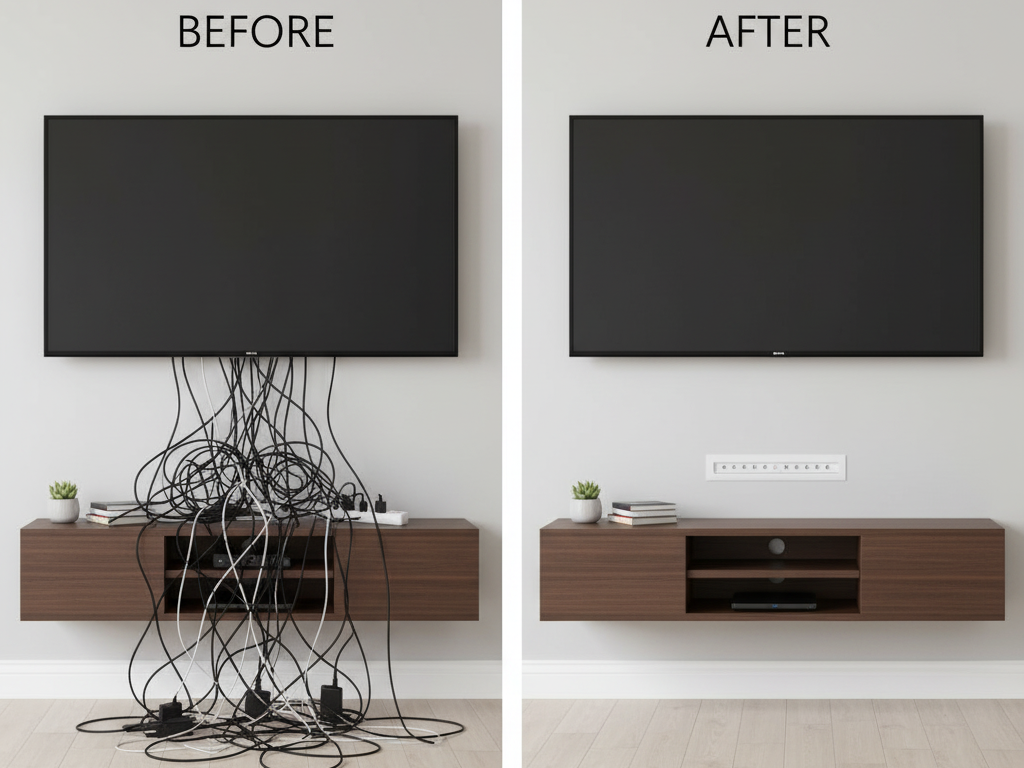
Recessed power kits specifically designed for TV installations provide legal alternatives for hidden outlets. These systems route properly conduit-protected cables through walls, terminating in flush-mounted outlets behind TVs.
Installation requires professional expertise ensuring code compliance and safety. The modest investment in proper electrical work prevents future problems that code violations cause.
HDMI cables, network wires, and antenna connections don’t carry electrical hazards but still require protection. Running these signal cables alongside power wires introduces electromagnetic interference degrading picture and sound quality.
Proper separation distances maintained during installation prevent these signal problems. Professional installers understand cable interaction principles, positioning wires to optimize performance while maintaining safety margins.
Cable Concealment Methods for Visible Routing
When in-wall routing isn’t possible or practical, multiple methods hide cables running along wall surfaces. Flat cable covers provide low-profile wire channels that blend with wall colors when painted to match. These covers accommodate multiple cables while maintaining slim profiles suitable for mounting behind TVs.
Adhesive backing simplifies installation without additional fastening. However, covers remain visible close inspection and create slight wall irregularities.
Conduit systems enclose cables within protective tubing, offering superior protection and cleaner appearances. Plastic conduit bends around obstacles while maintaining continuous cable protection. Metal conduit provides maximum durability in high-traffic areas but requires more visible installation space.
Both types can be painted to match walls, effectively concealing routing paths. Conduit also protects cables from physical damage and accidental puncture from future wall modifications.
Wall-mounted cable trays route multiple cables efficiently, separating power and signal lines to prevent interference. These metal or plastic systems mount directly to walls, accommodating substantial cable quantities. They work effectively in utility spaces but appear industrial in living areas. Concealing trays within cavities or behind furniture improves aesthetics while maintaining accessibility for future modifications.
Our mission at Golden Antenna is to support our clients in enhancing their homes and lives through reliable and expert antenna installation. We guide clients to achieve seamless connectivity and a stress-free viewing experience, aligning every installation with their needs and lifestyle.
The excitement of getting exactly what you want combines with the personable feeling of being understood, creating a safe, judgment-free zone where your entertainment needs receive proper attention.
Strategic Outlet Placement and Cable Organization
Positioning power outlets optimally reduces cable routing distances and complexity. Outlets mounted directly behind TVs eliminate long cable runs across walls.
This approach requires electrical work but delivers superior aesthetics compared to routing cables to distant outlets. Multiple outlets behind TVs accommodate various devices—soundbars, streaming devices, game consoles—reducing clutter from tangled cords.
Cable organization systems keep multiple wires grouped tidily. Velcro cable ties adjust easily during future modifications without damaging insulation. Spiral wraps consolidate cables into unified bundles that appear cleaner than individual trailing wires.
Labeled tags identify each cable’s purpose, simplifying troubleshooting and future adjustments. These organizing techniques work alongside physical concealment, creating polished final appearances.
Device placement influences cable requirements. Mounting soundbars below TVs creates vertical cable runs requiring less visible routing. Positioning streaming devices on shelves beside TVs allows shorter cable connections.
Considering device locations during installation planning reduces final cable management challenges. Professional installers assess all equipment and connectivity requirements before beginning work, designing cable routing that accommodates complete systems.
Common Cable Management Mistakes
Exceeding cable bend radius limits damages internal wire insulation gradually. Bent cables develop internal breaks that create intermittent failures weeks or months after installation. Manufacturers specify minimum bend radii—HDMI cables typically require 5-7cm radius bends.
Routing cables through tight conduit bends or sharp wall corners violates these specifications. Professional installers maintain proper curve radii throughout installations, preventing future failures.
Mixing power and signal cables invites electromagnetic interference degrading picture and sound quality. Even proximity to power cables affects sensitive signal transmission. Maintaining 15-20cm separation between power and signal lines prevents interference.
When routing through walls, these cables require separate pathways. Routing them through shared conduits defeats the purpose of proper cable management.
Using inadequate fastening allows cables to loosen and shift within walls. Movement stresses connections and creates intermittent failures. Professional installations use proper clamps and supports maintaining fixed positions throughout cable runs. Accessibility points allow future maintenance without disturbing entire installations.
Adelaide-Specific Cable Management Considerations
Heritage properties face restrictions on external modifications affecting cable routing options. Regulations often prohibit visible external antennas or conduit systems, limiting concealment methods to in-wall routing.
Heritage advisors approve installations before beginning work. Professional installers familiar with heritage requirements navigate these restrictions while delivering hidden infrastructure meeting regulatory approval.
Older Adelaide homes with plaster walls present drilling challenges. Lath-and-plaster construction features irregular framing that complicates stud location. Hidden asbestos materials in pre-1990s homes create health hazards during drilling.
Professional assessment identifies these risks before drilling begins, protecting occupants from dangerous fiber exposure. When asbestos presence is confirmed, specialized removal contractors handle modifications safely.
Adelaide’s variable climate affects cable materials. Temperature swings cause expansion and contraction in wall cavities. Quality conduit systems accommodate these movements while maintaining cable protection.
Cheap systems develop gaps allowing moisture infiltration that damages cable insulation. Professional installers select climate-appropriate materials ensuring long-term reliability despite seasonal temperature variations.
Professional Cable Management Advantages
Expertise eliminates guesswork regarding cable routing safety. Professional installers coordinate with electricians ensuring electrical code compliance. They assess structural elements protecting cables from damage.
Their experience prevents mistakes that cause immediate failures or problems emerging months after completion. This expertise justifies professional assistance rather than attempting DIY approaches with unknown risks.
Comprehensive cable management integrates all systems into unified solutions. Installers consider TV mounting, antenna connections, power requirements, and entertainment device placement simultaneously.
This holistic approach creates coordinated systems where all elements function together optimally. DIY attempts typically handle each component independently, missing integration opportunities that improve overall functionality.
Warranty coverage protects cable installations against future failures. Professional services guarantee workmanship for specified periods, addressing any issues without additional charges. This protection provides peace of mind that DIY cable management simply cannot offer.
Asking how do you hide cables from wall mounted tv reveals that beautiful installations require professional expertise coordinating mounting, electrical work, and cable management.
Golden Antenna brings comprehensive knowledge of cable routing regulations, Adelaide building codes, and aesthetic optimization. Located in Adelaide S.A. 5000 and reachable at 0403 711 983, we provide complete installation services managing every aspect from equipment mounting through final cable concealment.
Our approach combines technical precision with aesthetic vision, creating installations where infrastructure remains invisible while performance remains perfect. We handle coordination with licensed electricians, ensuring all electrical modifications comply with Adelaide regulations while delivering seamless hidden outlets and properly routed power connections.
Frequently Asked Questions
Q: Can I run power cables through walls myself?
A: Power cable routing through walls requires licensed electrician expertise ensuring code compliance and safety. DIY attempts violate building codes and create electrical hazards including fire risks.
Q: How much does professional cable management cost?
A: Costs vary based on installation complexity, required electrical work, and cable routing distance. Professional assessment provides accurate quotes accounting for your specific situation’s requirements.
Q: Will hiding cables affect TV reception?
A: Properly routed cables maintain signal quality when separation distances between power and signal lines are respected. Poor routing practices introduce interference degrading reception—professional installation prevents these problems.
Q: Can I use any cable covers or conduit?
A: Cable rating and specifications matter significantly. Cheap covers offer minimal protection while quality options provide durable concealment. Professional installers select materials matching your specific cable types and installation environment.
Q: Do hidden cables require future maintenance access?
A: Professional installations include accessible points allowing future modifications without disturbing entire cable runs. Planning these access points during initial installation prevents headaches during future changes.
Conclusion
Understanding how do you hide cables from wall mounted tv extends beyond cosmetic wire concealment—proper cable management requires electrical code compliance, safety considerations, and technical expertise preventing damage to hidden infrastructure.
Common DIY mistakes including improper power cable routing, excessive cable bending, inadequate fastening, and poor cable organization compromise both safety and functionality. Adelaide’s specific building regulations, heritage restrictions, and varied construction methods demand local expertise.
Rather than attempting cable management alone and risking electrical code violations or infrastructure damage, professional installation delivers hidden systems meeting safety requirements while creating seamless aesthetics. Golden Antenna provides comprehensive cable management coordinating mounting, electrical work, and concealment into unified solutions. Contact us at 0403 711 983 for professional installation transforming cluttered cable situations into invisible infrastructure supporting optimal viewing experiences.
